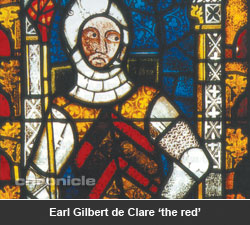
Earl Gilbert de Clare 'the Red'
Born in 1243, Gilbert de Clare, the son-in-law of King Edward I, inherited his father's estates in 1263 and rose to become one of the most powerful men in England, second only in wealth and power to the royal family. At the age of 19, he held lands in Glamorgan, Gloucester and Hereford and his annual income amounted to well over one million pounds in modern terms. Such was de Clare’s power and influence that the dying Henry III made him promise that he would not disturb the peace of the realm, as only prince Edward (later King Edward I) stood between Gilbert and the throne. It may have been his intention to make the grand castle at Caerphilly his royal residence in Wales.
Following his succession, Gilbert de Clare joined rebel barons who were protesting against Henry III placing foreign friends and relatives in office and usurping their power. At the battle of Lewes in 1264, de Clare fought under rebel leader Simon de Montfort, but switched his allegiance back to the king when the barons agreed to recognise Llewelyn ap Gruffydd as Prince of Wales in June 1265. Gilbert feared that he would lose his territory and influence in the Marches because Llewelyn already had the allegiance of all Wales up to the borders of Glamorgan.
In August, the royalist forces defeated the barons at the battle of Evesham and the king relinquished his control over Gilbert's Welsh lands - also allowing him to take possession of any rebel territory he could. However, in 1266, Gilbert once more rejoined the side of the rebel barons, claiming that his services had not been properly recognised. In April the following year, he marched to London to confront the king and persuade him to return the lands of the disinherited barons.
Gilbert began the construction of Caerphilly castle when when the treaty of Montgomery was signed in September 1267 as this formally recognised Llewelyn ap Gruffydd as Prince of Wales. Llewelyn’s new position allowed him to legitimately leap to the defence of Gruffydd ap Rhys, lord of Senghenydd, expelled from his lands by de Clare at the beginning of that year. If Llewelyn reinstated him, it would bring Welsh rule within miles of Gilbert's territory again.
Llewelyn seized Senghenydd in September 1268, beginning an aggressive and ongoing border dispute with de Clare which was to last until the king's declaration of war on Wales in 1274. It was not until the end of the second Welsh war in 1283, during which Llewelyn was killed that Gilbert finally occupied and fortified the disputed territory.
Gilbert took advantage of a minor uprising in 1287 and cleared the road to Brecon. He began to build a fort at Morlais to guard his new frontier, which caused friction with his neighbour, Lord Humphrey de Bohun, who disputed his rights to both territory and castle. The dispute became so heated that both earls eventually appeared before Parliament and were tried, convicted and fined by the confiscation of their Welsh estates. However, the king soon relented and both men were released upon payment of a fine; their estates restored. Perhaps the marriage of the recently divorced de Clare to the king's daughter, Joan of Acre, in 1271 helped to keep him in favour.
Widespread Welsh revolt between 1294 and 1295 forced Gilbert and his family to retreat to their English estates. The local rebel leader, Morgan ap Maredudd, had been dispossessed of his lands by de Clare and directed attacks in Glamorgan at the de Clare's holdings. Gilbert led a counter-attack in May 1295, re-gaining possession of Cardiff, although the revolt did not subside until the king intervened in June.
Earl Gilbert de Clare died on December 7, 1295. He was commemorated by the 'Chronicles of the Princes' as "the man of gentlest blood and most powerful amongst the English."
Image date: unknown
Location: unknown
Submitted by: unknown
Do you have any stories, images and interesting facts relating to this picture. Help Chronicle build a website of your Caerphilly County Borough memories. Email the webmaster telling us as much as you can about your pictures. Thank you
Description: