Tramroads
The first recorded proposal for rail communication from Rhymney was the ambitious idea to build a tramroad running from Carno Hill, at the head of the Rhymney Valley, to join with the Cardiff and Merthyr tramroad. Although this early proposal was never carried out, a network of tramroads was established across the district.
In 1802, the Canal Act of the 26th June sanctioned the construction of the Sirhowy Tramroad. Monmouthshire Canal proprietors were able to construct a tramroad from Newport to a point 9 miles towards the Sirhowy Valley between Wattsville and Cwmfelinfach. Under the Act of Parliament, the canal company could build a tramroad to any point eight miles from their canal. As Sir Charles Morgan of Tredegar agreed to build one mile of the tramroad through his Tredegar Park, which became his "golden mile", the Monmouthshire Company were able to add this mile to their permitted eight and built to a point nine miles from Newport. Near this spot the Penllwyn Tramroad joined, bringing coal from mines on the east bank of the Sirhowy River up to near Blackwood. In the early days of tramroads, wagons were horse drawn. Each wagon carried a maximum of three tons, later to be reduced to a maximum weight of three tons including the wagon.
The money for building the tramroads came from wealthy landowners, ironmasters and other entrepreneurs. At this time, many farmers supplied the horses and were dependent on the execution of contract work for large parts of their income.
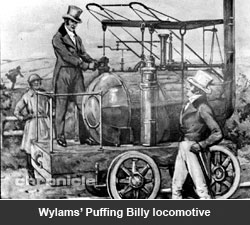
Eventually, many of these tramroads were sold to developing rail companies and converted for use by steam locomotives. Journey times were halved by the introduction of these locomotives, although they were still limited to speeds of ten miles per hour or less. These early innovations led to the rapid development of the rail network throughout the mid 19th Century.
Railways superseded both canals and roadways as they were more flexible and able to adapt to changing transport requirements. In 1830, just 157 km of track was scattered across the country: by 1880 this figure had grown to 25,000 km. As there were no plans for a unified network, a formula for railway construction was not adhered to for the first twenty years of building. After this period, the government realised the benefits of a nationalised system and insisted on a standard gauge for the track. However, as with canals, separate charges were laid down for using tracks belonging to each company, hindering long distance trade and transportation.
As railways provided direct inland freight movement across Britain for the first time, they had many advantages over the canals. Moreover, the advent of steam provided cheaper and faster methods of transport, which created a number of advantages:
- The speedy movement of goods meant that perishable goods such as fish and milk were available in town.
- Rail transport generated considerable improvements to the postal system and speeded up the distribution of information
- The provision of first, second and third class travel made it possible for many people to go on holiday for the first time.
In the second half of the 19th Century, railway owners set about monopolising the transport market. To control competition, increase rates and gain traffic, many companies purchased nearby canals, either closing them down or allowing them to deteriorate. By the middle of the 19th Century there remained very few canals with the ability to compete with the new railways. The majority of these canals were run by railway companies; normally because they serviced areas without rail lines or regions served by competing rail companies. Some canal owners retained their hold on the market by filling in their canals in and building railway lines on top.
Image date: unknown
Location: unknown
Submitted by: unknown
Do you have any stories, images and interesting facts relating to this picture. Help Chronicle build a website of your Caerphilly County Borough memories. Email the webmaster telling us as much as you can about your pictures. Thank you
Description: