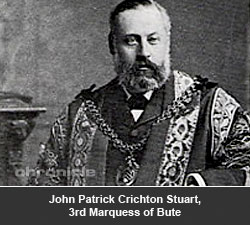
John Patrick Crichton Stuart, Third Marquess of Bute
Born on the isle of Bute in 1847, the son of John Stuart, second Marquess of Bute, John Patrick Crichton Stuart succeeded to the title of third Marquess at the age of six months. As well as becoming a baronet of Nova Scotia, he inherited twelve other titles including that of the Earl of Windsor, Mountjoy and Dumfries. He owned property in eight counties, large estates in Wales and Scotland but had inherited debts totalling £493,887, mostly due to the second Marquess's investment in the development of Cardiff Docks. However, the demand for Welsh Steam coal rocketed with the onset of the Industrial Revolution. It was shipped through Cardiff Docks and the turnover from this enterprise is reputed to have made the Marquess the richest man in the world.
The Marquess was baptised as an Anglican, but while studying at Oxford in 1866 abandoned the Presbyterian Church in favour of Catholicism. Bute’s personal feeling was that the Roman Catholic Church was the true Church of God because it had not been corrupted by reformation. However, Bute’s views were not shared by his trustees and his proposal caused considerable unease in the Lord Chancellor’s court. John was dissuaded from changing his faith until he came of age in 1868. It is thought that these actions and circumstances inspired the plot of Disraeli’s novel ‘Lothair.’
Stuart was fascinated with subjects such as religion, theology, astrology and mysticism and whilst at Oxford read books spanning many ancient faiths and the entire topic of comparative religion. His lifelong fascination with the occult lead him to experiment with telepathy and hold seances at his estates in Cardiff and Scotland, eventually becoming Vice Chairman of the Physical Research Council.
The Marquess had a great interest in architecture, reputedly spending £600,000 on restoring his Scottish seat, Mount Stuart. (This sum included an unspecified amount spent on stocking the garden with Kangaroos.) During a visit to Cardiff in 1865, the young Stuart met William Burges, an eccentric architect some twenty years his senior. Both men shared an obsession with the medieval world and an idealised Victorian vision of fairytale ruins, romance and decorative pre-Raphelite art. They based their reconstructions of Cardiff Castle and Castell Coch on their own interpretations of medieval style.
Work began on Cardiff castle’s South Wall when Lord Bute attained his majority three years later. Construction was to continue throughout his life although the castle exterior was more or less complete by 1877. Some of the most inventive and unlikely additions to Cardiff Castle included the Clock Tower and a roofed wall walk with crenel-flaps. However, Burges also did restoration work on the Keep and original medieval walls and windows of the Western apartments whilst Bute insisted that a different colour of stone was used to distinguish original and reconstructed architecture. Several archaeological digs took place during the 1890’s, revealing Roman and Medieval walls and a Monastery.
Bute’s medieval style was adapted for modern living and included up to date plumbing and central heating; without this his wife, Gwendolen FitzAlan Howard, would not have consented to make it their home following their marriage in 1872.
Stuart’s vision for Caerphilly was for an accurate reconstruction of the ruins. Shortly after his succession to the title, he commissioned a thorough architectural survey of Caerphilly castle, carried out by distinguished civil engineer G. T. Clark. By 1871, the Marquess had re-roofed the Great Hall to host a banquet for members of the Royal Archaeological Society and to commemorate the 600 th anniversary of the castle and the building of the present roof timbers.
During the nineteenth century, the Marquess made huge investments in the budding industries of South Wales. These investments laid the foundations which transformed Cardiff into one of the world’s great industrial ports and made his son his fortune. However, the Marquess tended to leave business matters to others, preferring to concentrate on archaeology, writing and spiritual matters. These subjects also absorbed a large proportion of his £300,000 a year income.
In 1890, the Marquess became Mayor of Cardiff and was made Lord Lieutenant of Bute two years later. He died at the age of 53 on 9th October 1900.
Image date: unknown
Location: unknown
Submitted by: unknown
Do you have any stories, images and interesting facts relating to this picture. Help Chronicle build a website of your Caerphilly County Borough memories. Email the webmaster telling us as much as you can about your pictures. Thank you
Description: