The Impossible Dream
In 1272 Edward I was crowned King of England and he was determined to stamp his authority as sovereign. In Wales he was determined to succeed where past Kings had failed. His first action was to tame Llywelyn ap Gruffydd. This he did by forcing him back to his native Gwynedd. Edward then demanded he pay homage and began to encircle his land with a chain of new castles. Enraged, Llywelyn and his brother rebelled in 1282. Both were killed and Llywelyn's lands passed to the Crown and became a new Principality, subject to English rule. Edward then added further castles to his chain in an attempt to quash any further rebellion. Wales' dream of independence was over.
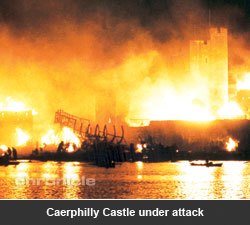
After Llywelyn's departure from Caerphilly in 1272, the Castle saw little or no action for over twenty years. With the main struggle now in the north, the Castle and the county borough were distant from the front line. However, these were far from settled times. Simmering beneath the surface was a bitter resentment to de Clare's unjust rule. This was fuelled by actions such as the enclosure of a new hunting park above the Aber Valley. It is likely that this upland was occupied at that time and so its creation would have forced local people from their homes and land. In 1294 this resentment violently surfaced when the Glamorgan Welsh revolted. They attacked the Castle and burnt Caerphilly Town. This unrest spread throughout the Lordship and into neighbouring Gwent. Similar uprisings occurred throughout Wales.
In 1314 the last of the de Clare male line died. With this Glamorgan passed to a series of Crown Keepers. These men were new to the area and unfamiliar with its ways. Unsympathetic to the Glamorgan Welsh and with past alliances and agreements, resentment again boiled to the surface. This ill feeling found a champion in Llywelyn Bren. He himself had been a victim of injustice, when he had been relieved of his position as a local official. Incensed, Bren rallied an army of ten thousand men. They attacked Caerphilly and besieged its Castle and left a trail of devastation throughout the county borough. To quash this rebellion, Edward sent an army to join the local Anglo-Norman lords. Pushing from Cardiff in the south and Brecon in the north, they attacked Bren's forces. A great battle took place at Cefn Onn, on the southernmost border of the modern county borough. Bren's forces were defeated and fled to the uplands of Senghenydd. Here they were cut off by the Anglo-Norman army attacking from the north. Defeat was inevitable and so Bren surrendered. He was then imprisoned in the Tower of London. For those that had fought with Bren, the penalty was high. Heavy fines and ransoms on their lands were just some of the means used to bring them to their knees. To make matters worse, the climate was deteriorating and famine was now widespread. The situation was desperate and this may well have led to the desertion of some settlements. Certainly the platform houses on Gelligaer Common were abandoned around this time.
When Eleanor de Clare married in the early fourteenth century, Glamorgan passed to her husband, Hugh Despenser. A close ally of Edward II, Despenser sought to strengthen the power and standing of Glamorgan. Among his first actions was to order the barbaric execution of the Lordship's most recent enemy - Bren. Resentment towards Despenser's greed and ruthless actions grew amongst the Anglo-Norman lords, who rose against him. Attacking key sites, including Caerphilly Castle, they banished him to England. However with the military support of Edward II, he defeated his enemies and returned to Wales. Despenser's wealth and power grew and he soon ruled over land from Chepstow to Pembroke. This success was short lived and his close alliance with the Edward II, was soon to be his downfall. On the wider stage Edward's weak and unpopular rule was under threat. Forced from England by his estranged wife Queen Isabella and Roger Mortimer, Edward II and Despenser fled to Glamorgan and took refuge at Caerphilly Castle. Both men then moved on before finally being captured. Meanwhile the Castle was besieged by the Queen's army. Despenser was later executed and Edward was allegedly murdered.
Image date: unknown
Location: unknown
Submitted by: unknown
Do you have any stories, images and interesting facts relating to this picture. Help Chronicle build a website of your Caerphilly County Borough memories. Email the webmaster telling us as much as you can about your pictures. Thank you
Description: